

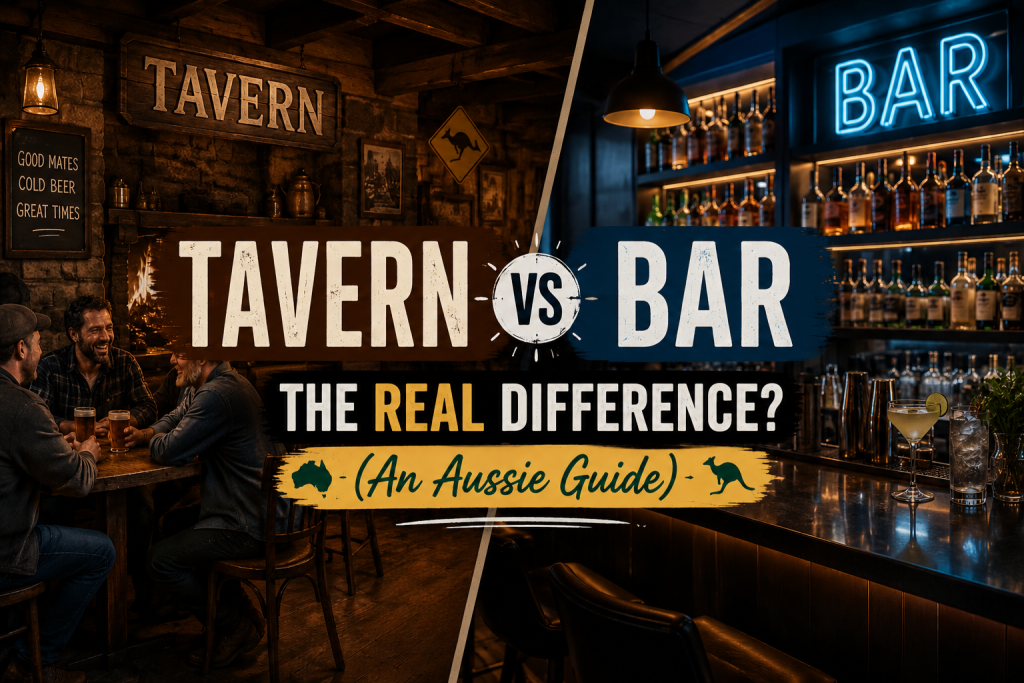
Most people use the terms “tavern,” “bar,” and “pub” interchangeably thinking they all mean the same. And in casual conversation, that’s fine most of the time. But, actually, they’re not the same. A tavern and a bar are built on different foundations, serve different purposes, and create completely different experiences; although sometimes they’re sitting on the same street in Perth.
It’s like sneakers and running shoes. Every running shoe is a sneaker, but not every sneaker is built for the full running experience. The same goes here. Every tavern has a bar, but not every bar has the food, the atmosphere, and the relaxed feel of a proper tavern.
In Western Australia, the difference between a tavern and a bar is both cultural and legal.
The licence class a venue holds shapes everything from whether kids can come in, to whether there’s a bottleshop attached, to how late they can pour.
So, this guide will get you the full picture. You will learn the historical backgrounds, their key differences, and the Australian context. So, you know exactly what you’re walking into next time.
What’s the Real Difference Between a Tavern and a Bar?
A tavern is a venue where people go for drinks, food, seating, and a more settled social experience. A bar is a broader category and may be focused mainly on serving drinks, with food ranging from full meals to light snacks or none at all.
In other words, taverns tend to feel more like a place to stay, while bars feel more like a place to drop in, drink, and move on.
That’s the main distinction, but the real difference becomes clearer once you look at the menu, the vibe, and the way people use each place.
Next, let us explore what each one actually means.
What Is a Tavern?
A tavern is a commercial establishment that focuses on selling alcoholic beverages for consumption on-premise, serving food and providing dining space for longer stay.
In modern use, a tavern usually feels:
- more relaxed than nightlife-driven venues
- more food-focused than a traditional drinks-only place
- more community-oriented
- more comfortable for sitting down and settling in
Ultimately, tavern is a type of venue where you have dinner, watch sport, order another round, and not feel rushed out the door. That is what gives it its easy, lived-in charm.
The History Behind ‘Tavern’
Taverns have been around longer than most countries on the map.
The story starts over 4,000 years ago in ancient Mesopotamia which is now Iraq; where some of the earliest recorded drinking and eating spaces existed. These weren’t rough watering holes. They were organised communal spaces where food and drink came together as a single experience. Sound familiar?
By the time of ancient Rome, the concept had split into two distinct experiences:
- The Taberna Meritoria: Upscale, full sit-down meals, reserved for those who could afford them
- The everyday Taberna: Accessible to ordinary Romans, combining food, drink, and conversation after a long day’s work
Both had one thing in common that modern bars don’t: the meal was always part of the deal.
Through the Middle Ages in Britain, taverns evolved into alehouses; part eating house, part inn, part community meeting point. They served one hot meal a day at a fixed time. Travellers slept there. Locals debated politics there.
In colonial America, taverns weren’t just popular; they were civic infrastructure. Town meetings happened in taverns. The Boston Tea Party was reportedly planned in one. They were the original third space. Not home, not work, but somewhere between the two where real community life happened.
Then came Prohibition in the United States (1920–1933). Here, everything shifted. The speakeasy, quick, secretive, drinks-first concept became the cultural blueprint for what we now recognise as a modern bar. The tavern, with its food and warmth and unhurried feel, gradually stepped back from the centre of social life.
But it never disappeared.
Today’s tavern is a direct heir of that centuries-old tradition – a neighbourhood institution built around comfort, familiar faces, good food, and a cold drink at the end of the day.
In Australia, it has found a particularly natural home. Taverns suit the way Australians actually socialise; relaxed, unpretentious, and always better with something decent on the table.
Speaking of what’s in the glass; that’s where bars tell a different story entirely.
What Is a Bar?
A bar is a retail establishment that serves alcoholic drinks for consumption on-premise and features a long counter for service.
It can look very different depending on the venue. Some bars are cocktail bars. Some are sports bars. Some are rooftop bars. Some are casual local bars. Some serve full meals. Some barely serve food at all.
A bar usually leans into:
- drinks-first service
- faster turnover
- a wider range of styles
- a more flexible nightlife identity
So, a tavern is usually a specific kind of drinking venue, while a bar is the bigger umbrella term. That is why people say a tavern is a bar, but a bar is not necessarily a tavern.
Bar History: Why the Word ‘Bar’ Covers Everything
A bar is one of the broadest categories in hospitality.
A rooftop cocktail lounge with a $22 Negroni and a dress code is a bar. So is the sticky-floored dive with a jukebox and no natural light. So is a sprawling sports venue with forty screens, a beer garden, and a three-page menu. All bars. All completely different.
The word itself comes from the physical counter; the wooden or metal barrier separating the person pouring from the person drinking. From that single plank of timber, an entire global industry has grown.
In Australia, the term “bar” arrived with British settlement and evolved separately from its American counterpart. While American bars were shaped heavily by Prohibition and the speakeasy era, Australian bars grew alongside the pub and hotel licensing culture. That is why, in WA today, most venues that call themselves bars are actually operating under a tavern licence. The name evolved faster than the paperwork.
What bars share, in principle:
- A liquor licence
- Drinks as the primary offering
- An atmosphere built around socialising
- Operating hours typically skewing toward the evening
Everything else including the food, the vibe, the entertainment, the décor, is negotiable. Bars don’t owe you tradition the way a tavern does. They can be intimate or enormous, rowdy or refined, themed or completely stripped back.
In Perth specifically, the bar scene reflects that full range. You’ll find laneway cocktail bars, craft beer taprooms, rooftop venues, sports bars, and neighbourhood locals. Many of which operate under a tavern licence but carry all the energy of a modern bar. The label on the door often doesn’t tell the whole story.
Now that the foundations are clear, here’s where taverns and bars actually part ways.
Tavern vs Bar: The Key Differences Explained
The difference isn’t just about the drinks list or the décor. It runs through the food, the atmosphere, the purpose, and the licensing (in Australia).
Here’s a breakdown of where the two genuinely diverge:
Food and Drink
- Tavern: Food is central, not optional. Expect a proper sit-down menu, daily specials, and a kitchen running full service. The traditional drink of a tavern is draught beer; the cold pint is the centrepiece. But a well-run tavern will carry the full range including tap beers, wines, cocktails, and spirits alongside a menu worth coming back for.
- Bar: Drinks are everything. Bars carry the full spectrum; craft cocktails, premium spirits, shooters, wines, mocktails. The kitchen situation varies enormously. Some bars serve outstanding food. Many don’t serve anything beyond bar snacks. At a pure bar, you’re there for what’s in the glass first and foremost.
Atmosphere and Ambiance
- Tavern: Warm, worn-in, and welcoming. Think timber panelling, soft lighting, the kind of place where the regulars know each other’s names. There’s a settledness to a good tavern. It feels like it’s been there a while and intends to stay. You can arrive alone, bring the family, or come with a group, and none of those feel out of place.
- Bar: The range is the point. Bars can be anything; a sun-drenched rooftop, a neon dive, a sleek cocktail lounge, a packed sports bar. There’s no single bar atmosphere. The common thread is energy and occasion, not tradition and comfort.
Community and Purpose
- A tavern is built around the idea of belonging. You can grab a solo pint at a bar and nobody notices. At a tavern, a sense of community infuses the room; closer to a neighbourhood café than a nightclub. People come back every week. The staff know your order. It functions as a genuine gathering place.
- A bar is built around the occasion. It could be a special night out, a post-work wind-down, a sporting event, or a spontaneous Friday. The connection is to the moment, not necessarily the place.
Entertainment
- Tavern: Relaxed and inclusive; trivia nights, live acoustic music, karaoke, weekly locals’ events. Entertainment built around regulars and community rather than one-off spectacle.
- Bar: Energy-driven and varied; DJ nights, live bands, themed events, late-night sessions, big-screen sport. In a sports bar especially; the entertainment IS the event.
The best neighbourhood venues in Australia have long blurred this line; and that’s actually the ideal outcome. More on that shortly.
Tavern vs Bar vs Pub: What’s the Difference in Australia?
This is where it gets genuinely useful for anyone in Perth. Because in Australia, these terms carry real legal weight, not just cultural meaning.
In everyday Australian conversation, “pub,” “tavern,” and “bar” are used more or less interchangeably. But under the Liquor Control Act 1988 in Western Australia, each licence class is distinct.
Licence Types in WA
Tavern Licence
It’s the most flexible liquor licence in WA. Authorises the sale and supply of alcohol both on the premises and as packaged takeaway liquor, typically through an attached bottleshop. A full tavern licence gives a venue significant operational flexibility.
Tavern Restricted Licence
It offers same on-premises flexibility as a full tavern licence, but no packaged takeaway liquor sales. No bottleshop attached. Usually still includes a food component.
Hotel Licence
This is the legal equivalent of what most Australians think of as a traditional pub. A hotel licence requires the venue to provide accommodation and meals; obligations a tavern licence does not carry. Many WA venues still carry “Hotel” in their name as a legacy of older licensing laws, even if they no longer offer rooms.
Bar (as a cultural term)
In WA, “bar” isn’t a specific licence class the way it is in parts of the United States. What locals casually call a sports bar or a cocktail bar is typically operating under a tavern or tavern restricted licence. The name on the door and the licence on the wall are two different things entirely.
One practical note: under WA law, kids can enter a licensed tavern if properly accompanied and supervised by a parent or guardian. This is one reason taverns tend to feel more family-accessible than bars or nightclubs.
Tavern vs Bar: Quick Comparison
| Feature | Tavern | Bar |
| Primary focus | Food + drinks + community | Drinks |
| Food menu | Full menu, daily specials standard | Varies; minimal to none in many venues |
| Drinks offering | Draught beer centred, full range | Full range, often cocktail-forward |
| Atmosphere | Warm, traditional, relaxed, inclusive | Varied; dive to rooftop lounge |
| Entertainment | Trivia, karaoke, live music, sport | DJs, live acts, late nights, sport |
| Family friendly | Yes (especially in WA) | Depends heavily on the venue |
| WA licence class | Tavern / Tavern Restricted Licence | Tavern Restricted in practice |
| Community feel | Central to the experience | Not always a defining feature |
| Best for | Locals, families, regular weekly visits | Occasions, nights out, drinks-first evenings |
Bar or Tavern – Which One Should You Choose for Your Night Out?
Choose a tavern when you want:
- food and drinks together
- a relaxed dinner with friends or family
- somewhere to watch the game
- a longer, easier evening
- a venue that feels comfortable and social
Choose a bar when you want:
- drinks first
- a more nightlife-driven atmosphere
- cocktails or a smaller drinks-led venue
- a quick stop rather than a full sit-down experience
- a venue that feels more casual, edgy, or stylish
A simple rule helps here: if the food, seating, and atmosphere matter as much as the drinks, you are probably thinking of a tavern. If the drinks are the main attraction, it is more likely a bar.
Still deciding where to head tonight in Perth?
Tired of venues that are either all drinks and no food, or all food and no atmosphere?
Visit The Russell Inn Bar & Restaurant: Where the Best of Both Worlds Actually Exists
The best modern venues sit somewhere between tavern and bar, and that is where the experience gets interesting. A place like The Russell Inn Bar & Restaurant gives people the food, drinks, and atmosphere they expect from a tavern-style venue, while still keeping the energy of a great local bar.
It is the kind of place where you can:
- sit down for a proper meal
- grab a cold beer or cocktail
- watch major sporting events on the big screen
- enjoy live music or karaoke
- meet friends for a casual night out
- bring the family and settle in comfortably
Family-friendly, open seven days, and always a reason to come in.
FAQs
What is the difference between a tavern and a bar?
A tavern is a licensed venue that places equal emphasis on food, drinks, and community atmosphere. A bar is primarily drinks-focused, with food being optional.
Is a tavern the same as a bar?
No. A tavern is usually a type of bar, but it tends to have more focus on food, seating, and atmosphere. A bar is the broader term and may be drinks-only or drinks-first.
Is a tavern the same as a pub in Australia?
In everyday Australian conversation, the terms are used interchangeably. Legally in Western Australia, however, a tavern licence is a distinct licence class under the Liquor Control Act 1988. A hotel licence (the legal equivalent of a traditional “pub”) carries additional obligations, including the requirement to provide accommodation, which a tavern does not.
What is a tavern restricted licence in WA?
A tavern restricted licence permits a venue to sell and serve alcohol on the premises only. It does not allow packaged takeaway liquor sales. It has the same on-site flexibility as a full tavern licence, just without a bottleshop.
Can children go to a tavern in Western Australia?
Yes. Under WA licensing law, children are permitted to enter a licensed tavern provided they are properly accompanied and supervised by a parent or guardian.
Is a sports bar classed as a tavern or a bar in Perth?
In Perth, most venues that call themselves sports bars operate under a tavern or tavern restricted licence. The experience includes big screens, live sport, food service, and weekly events. This aligns closely with the tavern model, even if the venue doesn’t use the word “tavern” in its name.
What drinks does a tavern serve?
A tavern traditionally focuses on draught beer, with a cold pint as the centrepiece. Modern Australian taverns carry a full drinks range like tap beers, bottled beers, wines, cocktails, spirits, mocktails, and soft drinks; alongside a complete food menu.
What is the difference between a bar and a restaurant in Australia?
A bar is primarily licensed to sell alcohol, with food being secondary or absent. A restaurant is primarily focused on food service, with alcohol available but not the main offering.
What type of venue is The Russell Inn Bar in Perth?
The Russell Inn is a family-friendly bar and restaurant in Perth, open seven days a week. It combines a full kitchen with daily specials, cold beers on tap, live sport on the big screen, weekly entertainment including trivia, karaoke, Chase the Ace, and DJ nights, plus live music from local bands. It operates with the community warmth of a traditional tavern and the energy and variety of a great modern bar.